

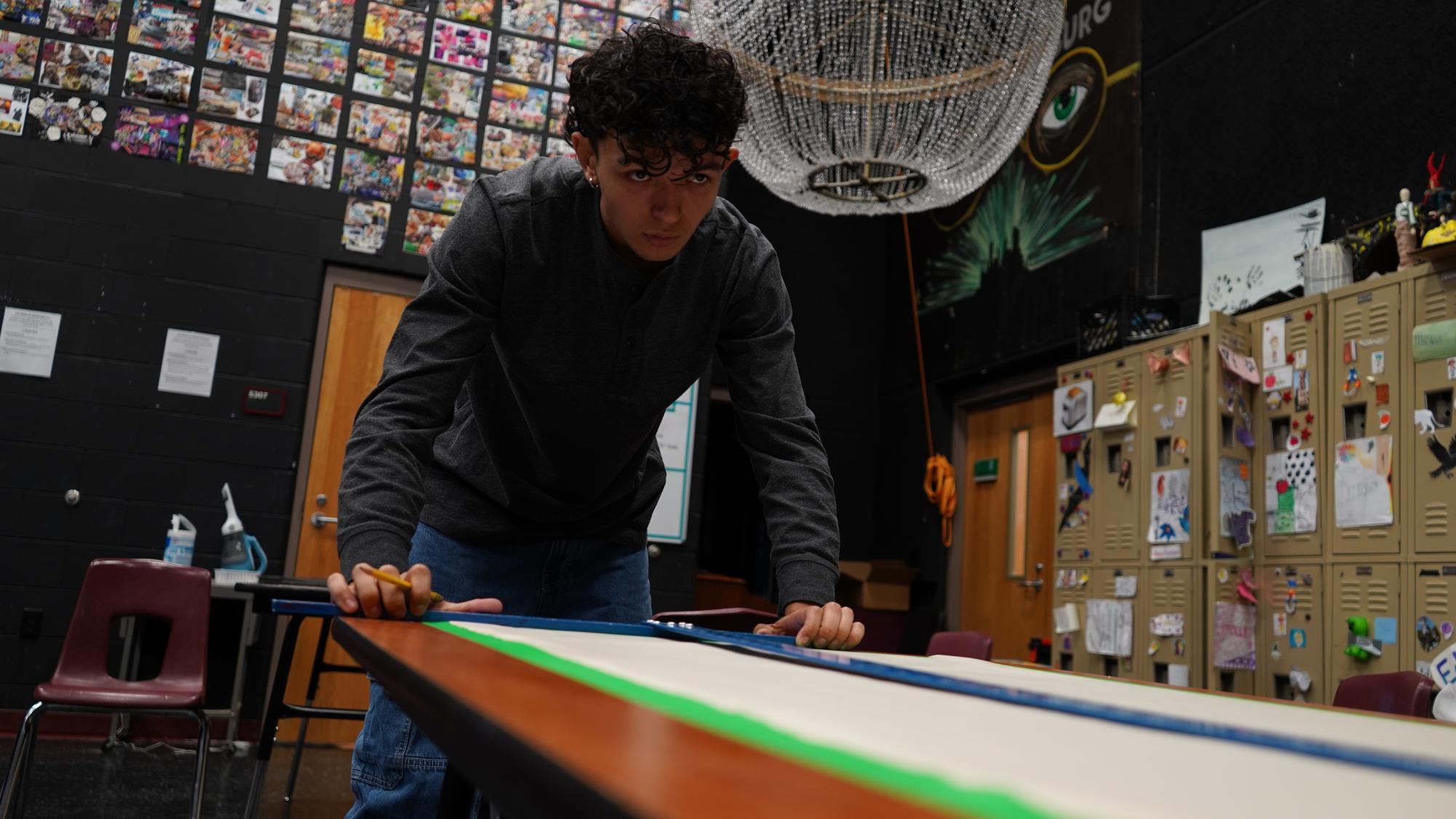
In the auditorium, the lighting crew prepares for the next cue while the costume crew tugs on collars and set pieces are rolled onto the stage. The 41 crew members all work together to make sure the production is smooth, clean, but most of all- safe.
Newsies technicians spent over 110 hours piecing together the production in nine weeks. The application process started in September through a form posted in the Newsies Google Classroom. A total of 64 students signed up for tech, marking the most crew applications for a production in recent history. In comparison, the musical Cinderella in 2025 had 48 applicants.
“By collaborating with my tech director, I’m able to bring this world to life through the physical,” senior deck captain Logan Deville said. “As a deck captain, oftentimes I get to use a lot of math to figure out very specific measurements.”
Deville is in charge of figuring out the logistics on how sets and scenes will look by working alongside technical director Charles McLean. Deville also did his research by watching the movie “Newsies.” According to Deville, the hardest challenge while making the set has been running out of materials and resources.
“As an artist, it’s refreshing to be a part of something bigger than myself,” Deville said. “With something as big as a musical, it takes a tribe to put it together. Being able to collaborate with everybody and allow for a creative medium to be on something besides just paper and canvas.”
To begin designing the show, McLean and the tech company read the script to figure out the themes behind the musical. Then, they researched by comparing other productions, studying pictures of the places and people the story is based on in order to make the show into their own. Hours of reference material from images of the characters to art styles from the 1800s all go into creating a period-accurate production.
“The amount of moving parts in this show is huge,” McLean said. “It’s been such an honor to get to work on, especially having done the show back when I was in high school. It’s one known by almost everyone, even people that aren’t into musical theatre.”
While actors are onstage rehearsing, stage manager senior Darbi Shawhan takes notes about what needs to be fixed, reworked and cleaned up to make the production better.
“A lot of [stage managing] is keeping people on track both in rehearsal and outside of rehearsal,” Shawhan said. “Just trying to make sure that everything’s in order as far as the direction of where we’re going and what needs to be done.”
Up in the booth, lighting head senior Moth Neal adjusts lighting cues and placements for every scene and number with precision. For productions, professional lighting equipment is rented out to fit the abilities necessary for the best performance. During tech week, crew and actors spend time going cue to cue to make sure lighting is in the correct position and timing. Working alongside Neal, freshman Colton Robinson helps make sure that the cues are hitting the right places.
“I find being a freshman in tech very special,” Robinson said. “Getting to learn from all the upperclassmen I find so amazing; getting to continue on traditions, knowledge and knowing one day you will be [like the upperclassmen].”
With a passion for graphic design and art, marketing head senior Emma Bannister created the designs seen on the shirts and posters. Drawing on her iPad, it took over seven different sketches for both director Painter and McLean to agree on the final design.
“It’s scary walking around school and seeing my work on everyone’s T-shirts,” Bannister said. “My tech director and my director, McLean and Painter, tell me what to do and what changes they like to see, and then I kind of make my own little twist on it.”
Bannister is most excited for the intermission between shows, where five posters signed by the cast and crew are auctioned off to the audience as a donation to the booster club, which funds the majority of every show the department does. The auction is a tradition done by the booster club at every production in order to raise money for the theatre program.
“It’s really cool getting to watch that and see that my work is going in that person’s house with all my friends’ signatures on it,” Bannister said. “It’s everything that we put our work into and they’re paying a lot of money for it and it’s really nice to see. I love it.”